

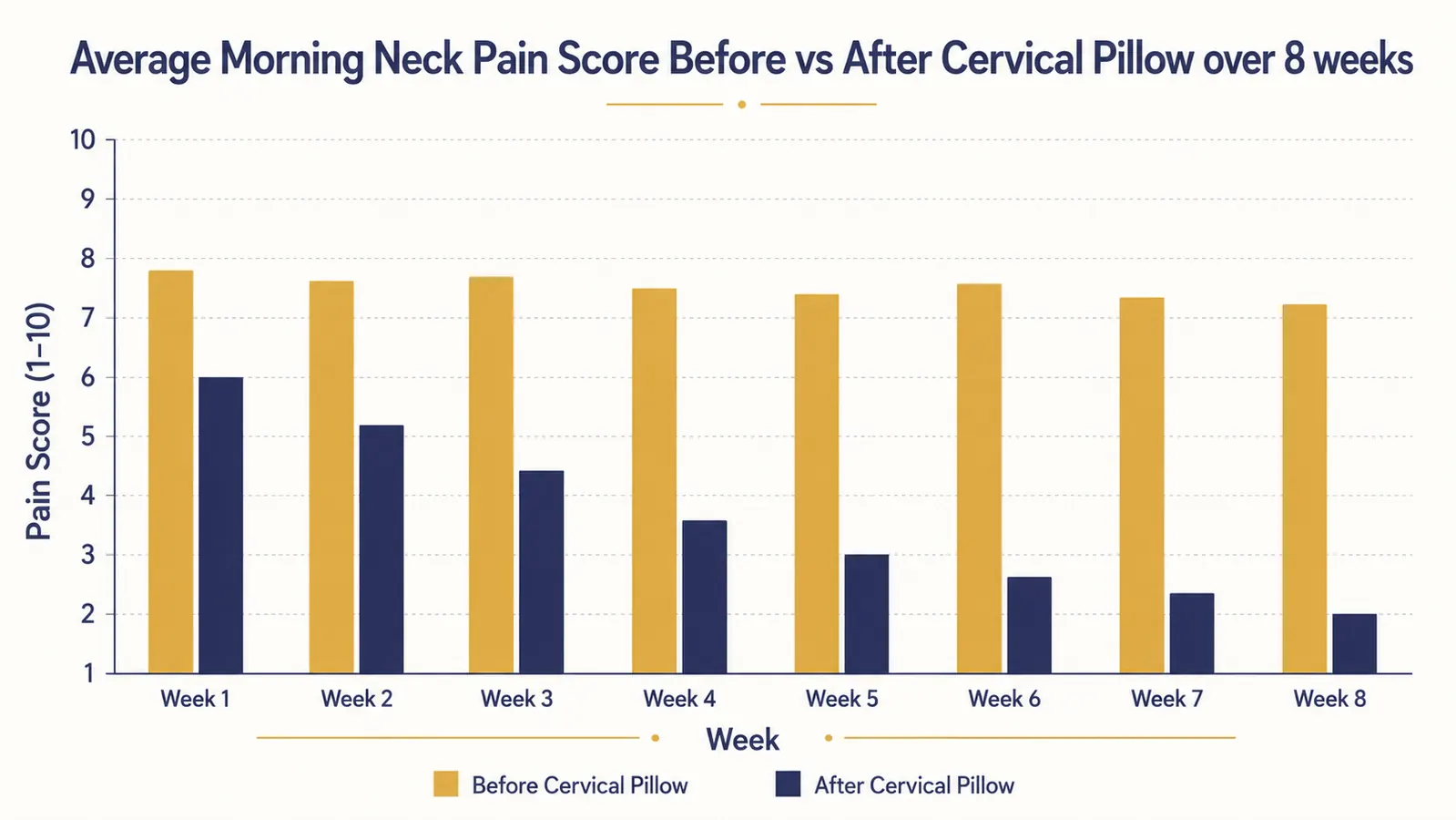
I woke up in pain every single morning for about fourteen months. Not a dramatic, can't-move-my-head kind of pain. Just that grinding stiffness across the base of my skull and the right side of my neck that showed up before I even opened my eyes. I'd lie there, already dreading the next few hours, already reaching for ibuprofen before I'd had a single sip of coffee. My doctor said my posture was fine. My mattress was six months old. Nothing obvious was wrong. Except the pillow. And I had no idea. The fix that finally worked for me was an EPABO contour pillow, and below is exactly how I use it.
Neck pain from sleep is one of those problems that gets written off as just bad luck or aging. It is neither. In most cases, the problem is that your head is spending six to eight hours a night in a position that puts continuous low-grade stress on the joints, muscles, and discs of your cervical spine. A standard flat pillow either lets your head sink too far (straining muscles on the side you sleep on) or props it too high (torquing the joints on the opposite side). A cervical contour pillow is designed to hold the head at a specific height relative to the shoulder, keeping the spine in a neutral position all night. The EPABO Contour Memory Foam Pillow is one of the most reviewed cervical pillows on Amazon with over 27,000 ratings, and it is the one I switched to. Here is exactly what I learned about making it work.
Still waking up stiff? The pillow you sleep on is very likely the problem.
The EPABO cervical contour pillow has two support ridges sized for different sleep positions and a removable washable cover. It comes with a pillowcase and a fill adjustment so you can dial in the height. Over 27,000 reviews.
Amazon Check Today's Price on Amazon →Step 1: Figure Out Which Sleep Position Is Actually Causing Your Pain
Before you buy anything, you need to know whether you are a side sleeper, a back sleeper, or someone who rotates between the two. This matters because side sleepers need more pillow height to bridge the gap between the ear and the mattress (typically four to six inches depending on shoulder width), while back sleepers need a lower, more gently curved support (typically three to four inches) that cradles the natural inward curve of the neck without pushing the head forward. Stomach sleepers are a harder case and are discussed at Step 5.
If you are not sure, ask someone to take a photo of you sleeping, or pay attention to where you are when you wake up. Side sleepers usually wake with pain concentrated on one side of the neck or at the shoulder-neck junction. Back sleepers more often get pain at the base of the skull or a general tightness across the upper trapezius. Knowing this tells you which lobe of the EPABO pillow to start sleeping on and which firmness insert to begin with.
One important note: if you wake up in a completely different position than you fell asleep in, that usually means your current pillow is uncomfortable enough that your body is constantly searching for a better spot. The problem is not your natural sleep position. It is your pillow.

Step 2: Choose the Right Lobe of the Contour Pillow
The EPABO pillow has two ridges across the top, a higher one and a lower one, separated by a curved valley in the middle. The higher ridge is for side sleepers. The lower ridge is for back sleepers. The valley holds the head when switching between positions in the night. When I first got mine, I read the packaging once and threw it aside, which meant I spent the first three nights on the wrong side and convinced myself it was not working. Do not do that.
Side sleepers: place your cheek and ear into the higher ridge. Your neck should rest in the curve that leads to the ridge, not on the ridge itself. The goal is that a straight line from the top of your head through your spine remains level with the mattress. If the pillow feels too high and your neck is bent toward your chest, move to the next step. If it feels too low and your shoulder is still compressing, the fill adjustment can help. Back sleepers: use the lower ridge. Your neck should rest in the curve, your head slightly elevated, and your chin neither pressed toward your chest nor floating toward the ceiling.
Step 3: Dial In the Fill Height Using the Zipper Insert
Most people skip this step. The EPABO pillow has a zipper on the side that lets you remove or add the shredded memory foam fill. Out of the box, it is packed fairly full, which suits people with broad shoulders or a larger frame. If you are on the smaller side or if the pillow consistently feels like it is pushing your head up too far, open the zipper and pull out a handful of fill. A sandwich bag's worth is usually about right for a medium-build person.
I removed roughly a cup of fill over the first week, checking each morning how my neck felt. By day eight I had it right. The tell that you have found the correct height: you fall asleep without consciously repositioning your head, and you wake up in roughly the same position you fell asleep in. If you are still waking at 3am to punch the pillow into shape, the height is still off.
The tell that the height is right: you fall asleep without repositioning, and you wake up roughly where you started.

Step 4: Align Your Shoulder, Not Just Your Head
A cervical pillow only solves half the equation if the shoulder underneath it is in a bad position. Side sleepers: when you lie down, your bottom arm should be extended slightly forward or tucked under the pillow's lower edge, not trapped underneath your torso. That trapped-arm position rotates the shoulder forward and changes the angle at which your neck sits on the pillow, negating most of the alignment benefit. Think about it as placing your shoulder into the mattress first, then lowering your head onto the pillow. Not the other way around.
Back sleepers have it a bit easier. Both arms can rest at your sides or on your stomach. What you want to avoid is sleeping with both arms above your head (the classic surrender pose), because that elevates the shoulder girdle and drags on the cervical muscles for hours. If you find yourself waking in that position regularly, try putting a thin pillow or a folded blanket under each elbow, which gives the arms a resting spot at a slightly elevated level and makes the above-head position less tempting.
Step 5: Handle the Transition Period Honestly
This is the part that most cervical pillow guides leave out. Switching to a cervical contour pillow after years on a regular one is a real adjustment, and the first three to five nights are often uncomfortable. Your neck muscles and the small stabilizing muscles around the cervical vertebrae have adapted to holding a suboptimal position. When you change the position, those muscles first have to relax out of a holding pattern they have been in for years, then rebuild in a slightly different configuration. That process produces mild soreness, sometimes in places you were not sore before.
I want to be direct about this because I almost returned the pillow on night four. The discomfort you feel in the first week is almost always the muscles adapting, not the pillow failing. Give it ten full nights before you draw any conclusions. The exception: sharp pain, tingling down the arm, or numbness. Those are neurological symptoms and you should talk to a doctor, not change pillows.
If you are a stomach sleeper, a cervical contour pillow is unlikely to help you, and no pillow fully addresses the problem because stomach sleeping rotates the neck to one side for hours. The real fix is learning to sleep on your side, which takes several weeks of deliberate effort. A body pillow pressed against your front side can help train the body to stop rolling onto the stomach.
What Else Helps Beyond the Pillow
A good cervical pillow is the highest-leverage single change you can make for sleep-related neck pain. But a few other things compound the result. First, your mattress firmness matters: a very soft mattress lets the shoulder sink below the level of the mattress surface, effectively raising the distance the pillow needs to cover and changing the alignment angle. If your mattress is old and soft and your neck pain is on the right side, check whether your right shoulder is sinking. A mattress topper that adds some firmness can help.
Second, screen time before bed affects neck position. If you read or scroll on your phone with your neck bent forward for the last forty minutes before you lie down, those muscles go into sleep in a contracted state and are more likely to stay contracted all night. Ten minutes of gentle chin tucks (chin moves straight back, not down, while you keep your gaze level) before sleep can reduce how much tension carries into the night. Third, if you have been in pain for more than a few weeks, a single session with a physical therapist who specializes in cervical spine can identify specific muscle imbalances that no pillow alone will fix.
For a deeper look at why contour pillows work at the design level, the article on 10 reasons a contour pillow helps neck pain covers the mechanics in detail. And if you want a full breakdown of eight months of nightly use before committing, the EPABO cervical pillow long-term review covers every stage of the experience.
If you have been waking up stiff for weeks, the pillow is the most likely culprit and the cheapest fix.
The EPABO cervical contour pillow costs less than a single co-pay, has a removable washable cover, and ships with the fill adjustment most competitors charge extra for. Worth trying before anything else.
Amazon Check Today's Price on Amazon →