
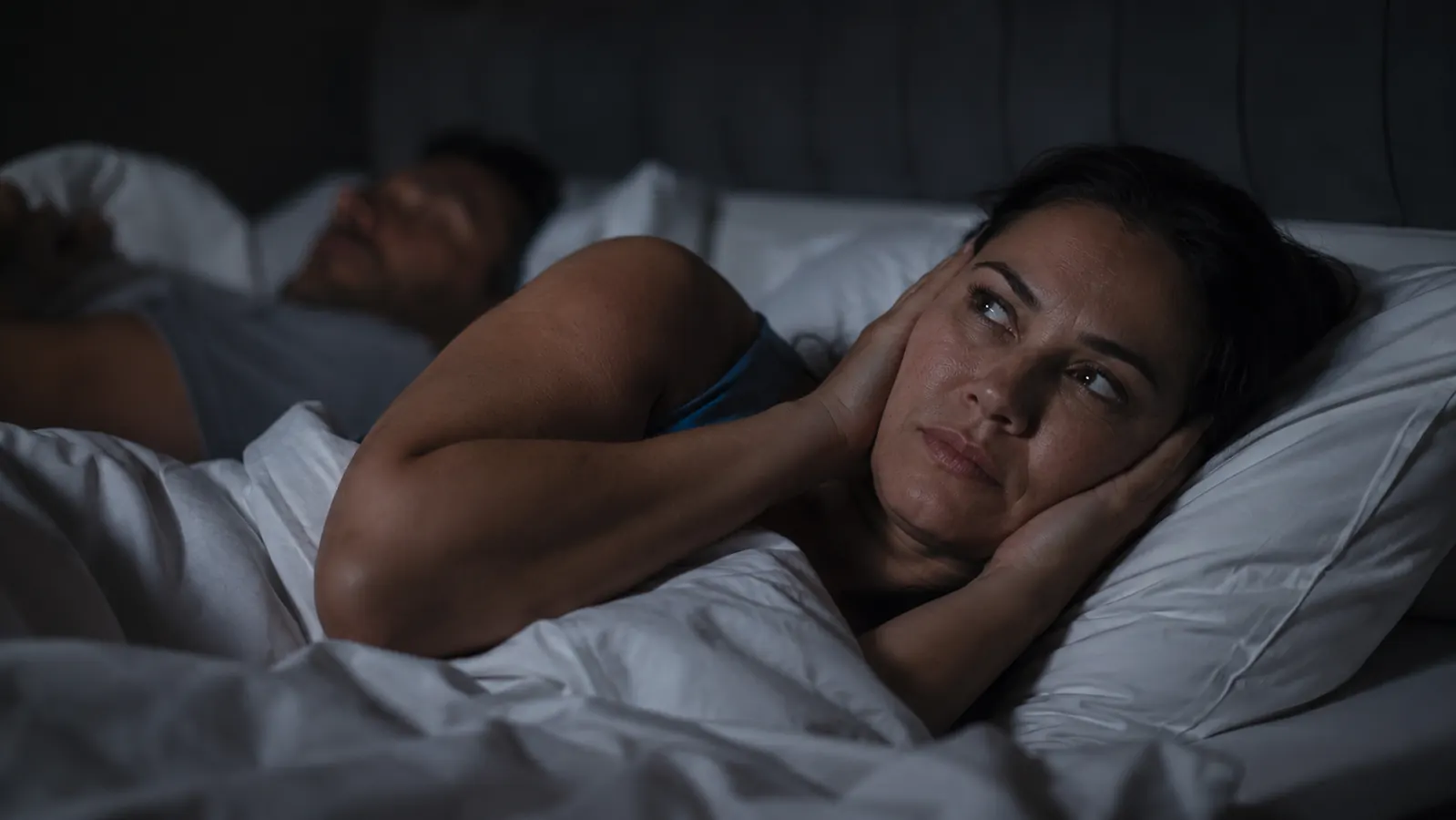
My partner Marcus has snored since the day we moved in together. Not a gentle hum. A full, rhythmic freight-train sound that starts the second he hits deep sleep, which is about four minutes after his head touches the pillow. I, on the other hand, need dead silence, complete darkness, and approximately forty minutes to drift off. For the first two years we shared a bedroom, I averaged maybe five broken hours a night. I tried earplugs. They helped a little, but I could still hear the low rumble underneath, and by 3 a.m. my ears ached from the foam. I tried a fan on the highest setting. It was too cold in December and not loud enough in summer. I tried moving to the couch. That solved the noise problem and created a different problem entirely.
What actually worked was a combination of the right sound masking tool, placed correctly, with the right settings for our room. The Magicteam white noise machine changed the situation in a way none of the other approaches touched. But placement, volume, and sound selection matter as much as the device itself. This guide walks through exactly what I did, step by step, so you can stop lying there in the dark doing the math on how many hours you have left if you fall asleep right now.
Still lying awake counting the seconds between snores? This is the machine that fixed it for me.
The Magicteam sound machine has 20 non-looping sounds, a full volume range, and a memory function that brings it back to your exact settings every night. Over 68,000 reviews. Check today's price before you spend another week on the couch.
Amazon Check Today's Price on Amazon →Step 1: Understand Why Sound Masking Works (and Why Silence Does Not)
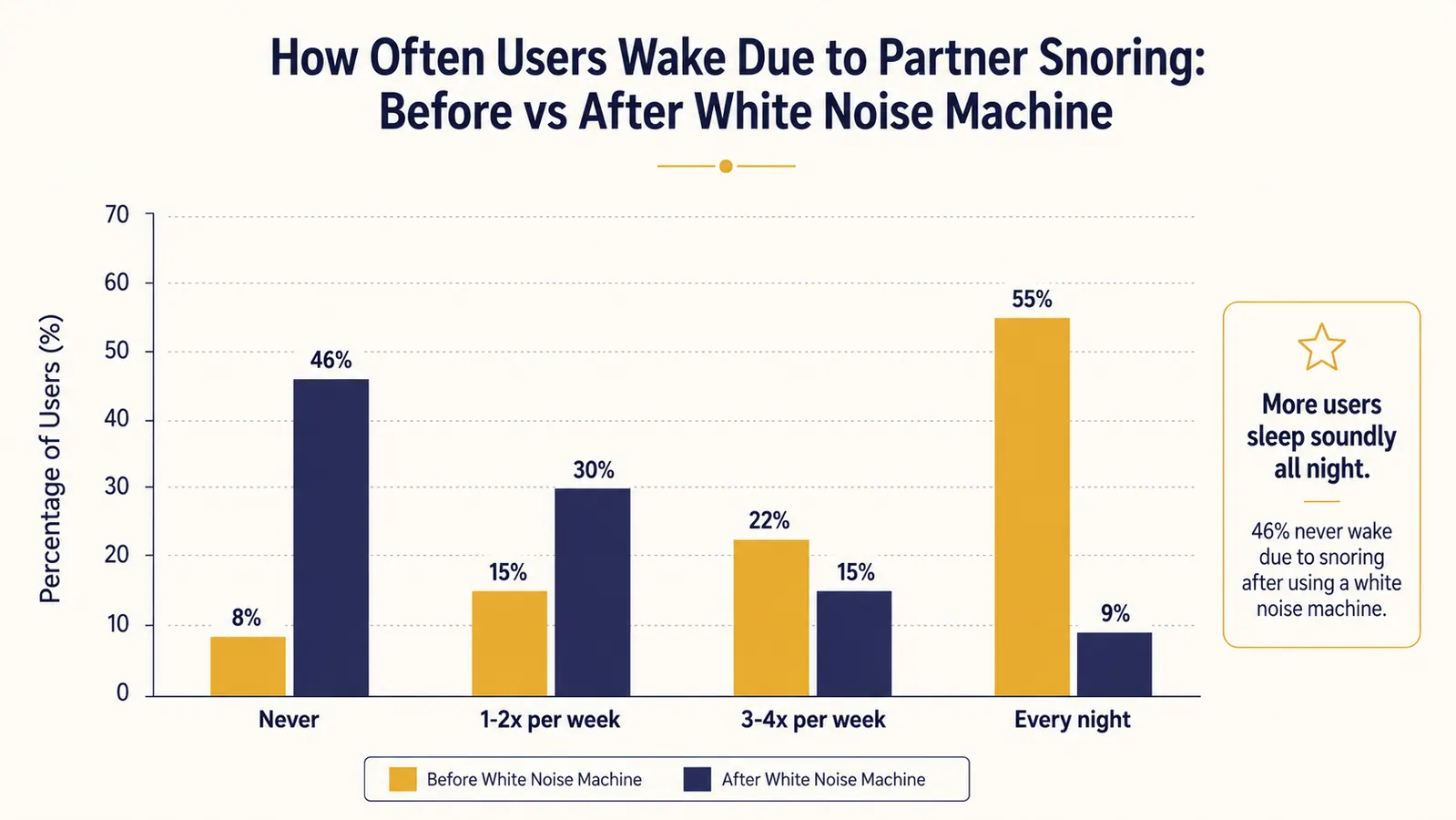
The first thing I had to accept is that you cannot eliminate snoring noise from a shared room without a medical intervention on your partner. What you can do is reduce the contrast between the quiet baseline of your room and the peak of each snore. That contrast, the sudden spike from silence to a loud rumble, is what jolts you awake or prevents you from falling asleep in the first place. Your brain is not wired to ignore unpredictable loud sounds in the dark. It treats them as potential threats.
White noise works by raising your room's ambient sound floor to a steady, predictable level. When the snore hits, it still happens, but the gap between your baseline and the snore is smaller. Your brain registers less of a jolt. The key word is steady. A fan on high creates some masking, but it cycles and pulses slightly with each rotation. A dedicated white noise machine emits a consistent, non-looping signal designed specifically for this purpose. That consistency is the difference between a bandage and an actual fix.
Brown noise and pink noise tend to work better than pure white noise for most adults because they carry more energy in the lower frequencies, which is exactly where snoring lives. When I switched from the default white noise setting on my Magicteam to the brown noise setting, the difference was noticeable within two nights. The lower register of the machine's sound filled in the same frequency range as Marcus's snoring, rather than just layering a hiss on top of it.
Step 2: Choose the Right Device for a Shared Bedroom
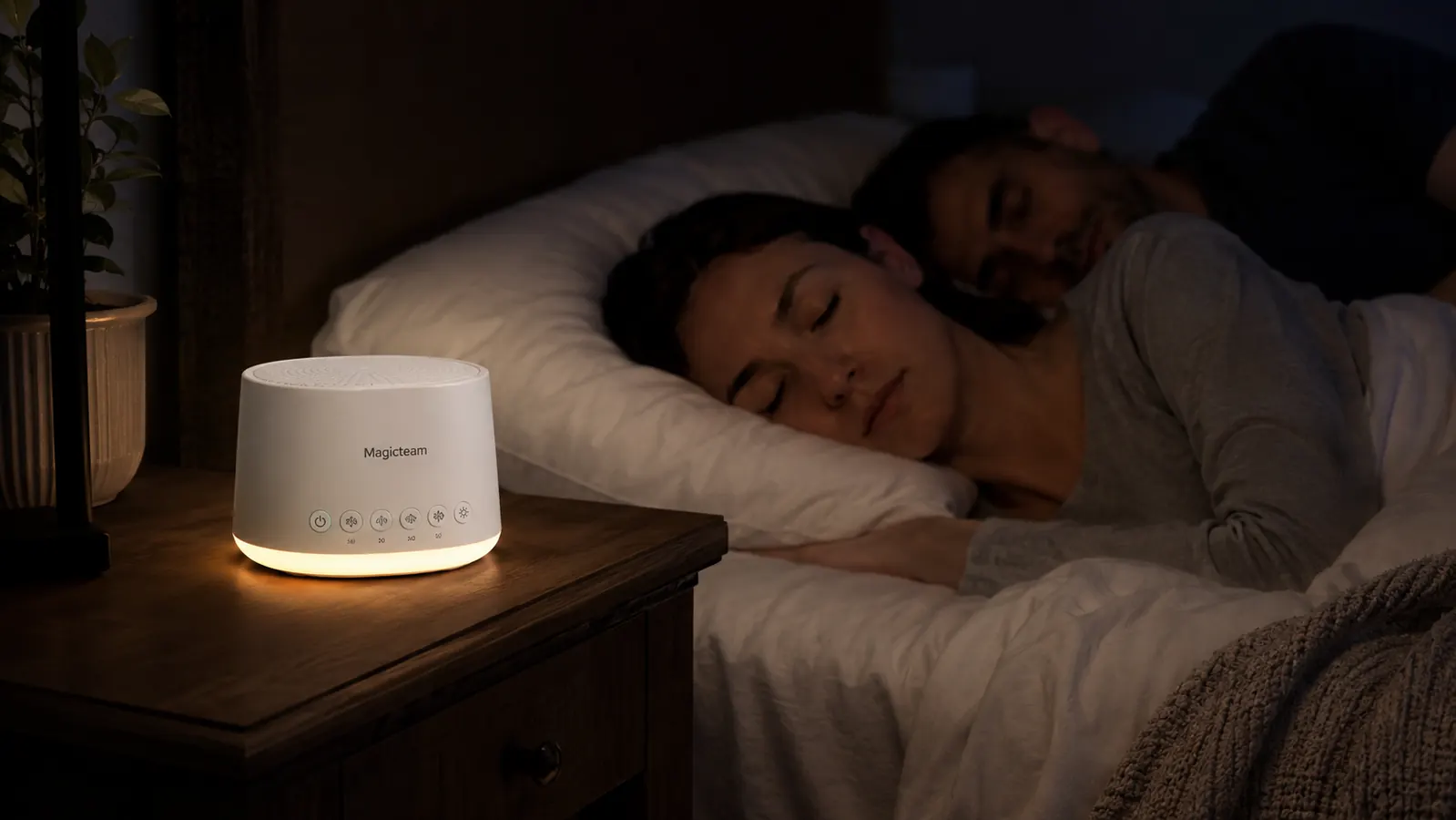
Not every white noise machine is built the same. The main things that matter for snoring situations are volume range, sound variety, and whether the sound loops. A looping machine creates a noticeable repeating pattern every thirty to sixty seconds, and once your brain learns the pattern, it starts tuning it out. Non-looping machines are meaningfully better for this application. The Magicteam plays 20 sounds without looping, which is why it made my shortlist in the first place.
Volume range matters more than most reviews acknowledge. For a snoring partner, you need enough volume to actually mask the noise, which often means running the machine louder than typical sleep guidance suggests. The Magicteam goes loud enough to cover a heavy snorer in a standard bedroom without needing the volume maxed out. I run mine at about 70 percent and that handles Marcus reliably. Anything that tops out at a gentle whisper is going to fall short.
The memory function is a small detail that adds up over months. The Magicteam remembers your last volume and sound selection when you turn it off and back on. Without that, every single night involves fiddling with settings in the dark. It sounds minor. After three hundred nights, it is not minor.
Step 3: Place the Machine on Your Side of the Bed
Placement makes a bigger difference than most people expect. The instinct is to put the machine in the center of the room or near the snoring partner to cover the noise at its source. That is backwards. You want the machine as close to your own ears as practical. Sound follows an inverse square law: the closer the source, the louder it is relative to everything else. A machine on your nightstand, two feet from your head, masks far more effectively than the same machine on a dresser six feet away at the same volume setting.
I put mine on my nightstand, angled slightly toward my pillow. The speaker faces me, not the ceiling. If you share a nightstand and there is no room, a small shelf or a stack of books works fine. The goal is to get the speaker within two to three feet of your head and oriented toward you, not the room in general.
If your bedroom is unusually large, or if your partner is a particularly loud snorer, a second machine on the other side of the bed is worth considering. Two machines at moderate volume outperform one machine on full blast in terms of even coverage and room acoustics. That said, for most couples in a standard bedroom, one Magicteam on your nightstand at the right volume is enough.

Step 4: Dial In the Volume and Sound Selection
Start on the brown noise or pink noise setting rather than white noise. White noise is effective but skews toward higher frequencies, and most snoring is mid to low frequency. Brown noise has a deeper, richer tone that fills in that lower range. Think of it like equalizing for the specific problem you have, rather than applying a generic filter. If brown noise feels too muffled to you after a few nights, try pink noise, which splits the difference between white and brown.
For volume, start at 50 percent and test for two or three nights. If you are still waking up from the snoring, increase by 10 percent increments until it stops disturbing your sleep. Most people with a loud snoring partner land somewhere between 60 and 80 percent. Going beyond that can affect your own sleep quality over time, so push the volume only as high as you need, not as high as it will go.
The Magicteam also includes nature sounds like rain, ocean waves, and a thunderstorm. These work for some people as a secondary option. I find that pure noise tones mask snoring more reliably than nature sounds because nature sounds have rhythmic patterns of their own that can be disrupted by an irregular snoring pattern. But personal preference matters. If rain sounds help you relax and fall asleep faster, start there and note how you feel over the first week.
Step 5: Build a Consistent Bedtime Routine Around the Machine
The Magicteam has a timer function that turns it off after 60, 90, or 120 minutes. My strong suggestion is to skip the timer entirely for the snoring use case. Your partner's snoring does not stop at 2 a.m., and if the machine shuts off, you lose your masking exactly when your sleep is lightest and most vulnerable to disruption. Run it all night. The power draw is negligible and the device is rated for continuous use.
Turn the machine on before you get into bed, not after. It takes a few minutes for your brain to register the sound as background rather than a new stimulus. If you flip it on right when you are trying to fall asleep, it competes for attention briefly. Starting it five to ten minutes before lights out gives you a smoother transition. Over time, the sound itself becomes a sleep cue, which speeds up how quickly you fall asleep.
I was skeptical that an inexpensive machine was going to fix a problem that had made me miserable for two years. It took about four nights to be certain it was actually working. That was eight months ago and it runs every single night.
What Else Helps
The white noise machine handles the sound problem. A few other things can improve the overall picture. A good sleep mask eliminates light disruption, which is the second most common reason I wake up after sound. Foam earplugs worn alongside the white noise machine are genuinely useful if your partner is a very loud snorer, because the combination of both approaches together covers more of the frequency range than either does alone. The earplugs knock down the peaks, and the white noise fills in the ambient contrast.
Room acoustics affect how well masking works. Hard surfaces, uncovered floors, and bare walls reflect sound and make snoring carry farther. Rugs, heavy curtains, and upholstered furniture absorb sound and soften the overall noise environment before the white noise machine even starts doing its job. If your bedroom is mostly hard surfaces, adding a rug under the bed makes a real difference in baseline noise levels.
Finally, if your partner's snoring is severe, it is worth raising the conversation about a sleep study. Loud, frequent snoring can indicate sleep apnea, which is a health issue beyond just being an annoyance to you. A white noise machine solves your sleep. A CPAP machine or dental appliance, if that is what is needed, helps both of you. The two approaches are not mutually exclusive. I use the Magicteam even on nights when Marcus sleeps in a separate room because I have trained my brain to associate the sound with sleep.
For more on how a white noise machine performs across different situations, including shift work and apartment noise, see my full Magicteam white noise machine review. And if you are still deciding whether this is the right category of solution for your situation, 10 reasons a white noise machine helps you sleep through anything walks through the underlying logic in more detail.
Eight months of sleeping next to a snorer, and this is still the only thing that reliably works.
The Magicteam Sound White Noise Machine: 20 non-looping sounds, adjustable volume, memory function, continuous use rated. At its current price, it costs less than a single bad night of lost productivity. Check today's price on Amazon and see what over 68,000 reviewers have to say.
Amazon Check Today's Price on Amazon →